
IDR Updates: The True Cost
It is clear that NSA has been a great solution to reduce the influx of unexpected out-of-network bills patients receive. It relieves the uncertainty and gives the patients a chance to challenge their bills to lower their costs. But this cost does not vanish; instead, it shifts. This shift affects providers, insurers and healthcare system as a whole. While the government is acknowledging this with recent regulatory updates, there remains a critical need for innovation.
Growing IDR Fees
Since its launch in 2022, the IDR process has generated at least $5 billion in costs by the end of 2024. This amount highlights the growing financial strain in the healthcare industry. Administrative expenses such as the administrative fee have risen to $115, while the IDR entity fee can range from $200-$840 for single determinations and $268-$1,173 for batched determinations. Recently, new rules have emerged that lowers the administrative fee to $15 but while it aims to lower IDR fees for smaller claims, it can lead to larger fees by volume. Payer costs may increase as IDR entity fees can range from $300 to $1,000 per dispute, often exceeding the value of the claim itself. As these costs continue to escalate, the need for a comprehensive solution to enhance the efficiency of the IDR process has become vital. Although the IDR process was designed to be a fair resolution to billing disputes, it has resulted in increased financial cost.
Source: Centers for Medicare & Medicaid Services (CMS), "Federal Independent Dispute Resolution (IDR) Process Administrative Fee and Certified IDR Entity Fee Ranges Final Rule Fact Sheet," December 18, 2023. cms.gov
Overwhelming Volume
In the beginning, a small volume of disputes was anticipated, but the reality has been proven different. The IDR process has been full of cases far exceeding what was expected, leaving a strain on providers and resulting in delays and errors. With the fundamental changes that are meant to help decrease the amount of disputes being handled, it could potentially lead to an increase volume instead. As an increasing amount of providers utilize the IDR process to address disputes, the system has an overwhelming amount of claims to get through, highlighting the urgent need for solutions to streamline and enhance the system.
Reliant’s Cost Effective Approach
Do not wait for regulations to solve these problems. At Reliant, we recognize how frustrating the IDR process is and are committed to providing innovative solutions that streamline this complex process. Our goal is to maximize savings with minimum noise.
How do we achieve this with IDR? We aim to keep you out of IDR right from the start.
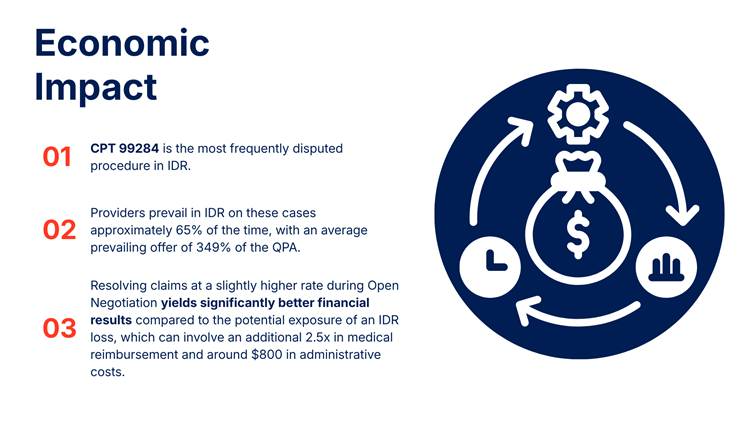
Reliant successfully keeps 94% of Open Negotiations out of IDR for our current clients. This achievement is made possible by having experts that understand the regulatory framework in depth, including pricing rules, prohibitive factors, and key economic considerations that are most impactful. While approximately 6% of Open Negotiations claims we manage do proceed to IDR, our performance remains strong. We currently prevail in 63% of IDR decisions on behalf of our payer clients, significantly higher than the industry average of approximately 20%.
With over 30 years of industry expertise in current NSA statues and regulations, our approach is designed to balance maximum defensibility, minimal provider abrasion, and strong financial outcomes through a disciplined, data-driven post-payment strategy.