
Winning Less Matters More: Independent Dispute Resolution
A recent webinar hosted by Health Plan Advantage, featuring Reliant Health Partners in collaboration with Western Health Advantage, explored topics that discussed the hidden cost of IDR and why winning less matters more. As IDR increasingly makes headlines and draws scrutiny from politicians, the need for different solutions and better regulatory education is of high importance. So how do we protect the affordability for members, maintain provider relationships, while still reducing the friction of out-of-network reimbursement?
Education Gaps, Financial Consequences
At the start of the NSA implementation, providers were new to the concept of a health plan determined rate. Due to the limited familiarity with the NSA process, providers often missed open negotiation periods, leading to delays and increased number of disputes. Although guidance has improved since then, there remains a critical need for a more comprehensive provider education to prevent further oversights and empower providers to navigate the NSA landscape confidently.
Another burden organizations see today is the financial exposure created by IDR outcomes. This creates a downstream effect mainly with the administrative workflow for reprocessing claims that leads to the rising volume of provider disputes and negotiations.
Proactive Steps to Avoid IDR
When thinking about IDR, we urge organizations to consider what proactive measures can be taken to avoid disputes escalating into IDR. For instance, having a team of experts that know how to interpret what’s on the claim form enables more meaningful conversations with providers. Additionally, it is crucial for these experts to grasp the clinical implications, especially given the case complexity that IDR entities increasingly emphasize. Organizations should take action and reevaluate strategies for negotiating with providers prior to payment going out the door.
The Strain on Internal Management
Today, most organizations handle their IDR disputes internally, initially assuming that the volume of disputes would be manageable. But with the dispute volume exceeding expectations and new regulations changing the administrative fee to $15 that can lead to larger fees by volume, organizations should brace for an influx of disputes. Some try to increase staff to handle this influx, but it isn’t the answer as it will only add to the administrative cost. Instead, partner with IDR experts to help evaluate the offers being made and compare these with what providers are accepting.
Turning Awareness Into Action
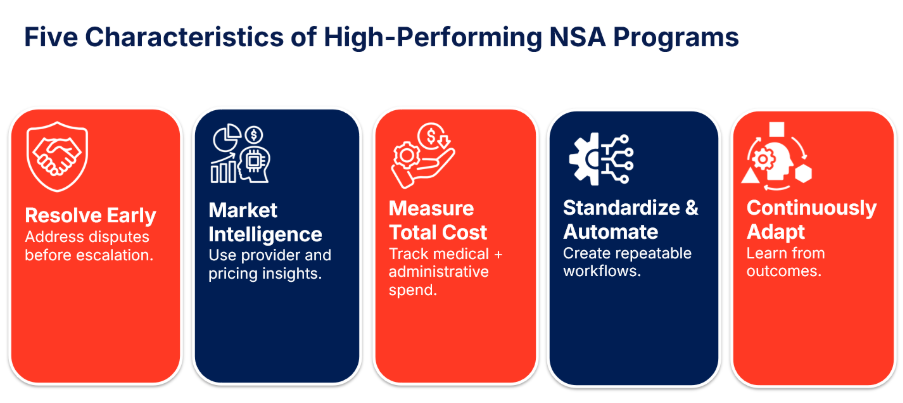
By the conclusion of our session, and based on the questions raised by attending organizations, one crucial metric emerged as a significant driver of boardroom discussions: reducing the claims that escalate to IDR. With IDR touching finance, compliance, operations and company reputation, it has become essential for organizations to implement strategies that minimize the occurrence of disputes.
Reliant has begun to sound the alarm for organizations, not to just raise awareness, but to encourage proactive steps in addressing NSA and IDR head-on. With our experienced team and a defensible QPA calculation, we can efficiently manage cases and avoid open negotiations.
While the road to minimizing IDR challenges is complex, Reliant remains committed to guiding organizations with our forward-thinking approach, helping them navigate NSA with confidence.
Connect with our team to discuss your NSA strategy.